Research Proposal in the Scholarship of Teaching and Learning:
Transcript: “Hi! I’m Sara and I am in Wildlife and Fisheries Sciences at Penn State. I would like to take about three minutes of your time to explain a research proposal related to the field of scholarship of teaching and learning.
Experiential learning, simply put, is “learning by doing”. Experiential learning facilitates the gain of new knowledge by the transformative process of knowledge through an experience. Instructors can make this most beneficial to students, and most successful for students, by using Kolb’s 1984 model of experiential learning theory as a pedagogical framework. When we put this into practice, we use five stages. Let me explain. The first is experiencing – this is the activity phase. The second is publishing, and this is where students reflect on the activity and share their observations. Third is processing, and this is where students make connections between the course content and the activity – identifying patterns, identifying dynamics. The fourth stage is generalizing where students connect what they have learned in class to real-world scenarios. The last stage is experimentation, or application, where students plan purposeful application of this new knowledge and can use it outside of the classroom or in the classroom in future experiences. At this point, the cycle can continue indefinitely!
So what does this have to do with Wildlife and Fisheries Sciences? Well, students typically enter the field because they love being outdoors or they love working with animals. Students may become biologists, but they may also become wildlife managers, policy makers, wildlife veterinarians, wildlife rehabilitators, environmental educators, scientists, or conservation officers. And the skills needed to be successful in all these careers can be facilitated through experiential learning. Research has already shown us that use of experiential learning in university level wildlife courses can help improve overall scholarship, increase the maintenance and retention of new knowledge, helps improve enthusiasm and motivation as well (Fedynich et al., 2012; McCleery et al., 2005; Millenbah and Millspaugh, 2003; Montgomery and Millenbah, 2011; McCleery 2015).
So clearly, experiential learning is beneficial to students. And in a 2015 paper (Stevenson and Peterson 2015) it was noted that the use of experiential learning within the university classroom has not yet been quantified. We as scientists need a baseline measure. Therefore, I am proposing two surveys to be distributed through the university education working groups of the Wildlife Society and the American Fisheries Society because there are over 150 wildlife and fisheries programs that can be reached this way across the United States (Kelso and Murphy, 1988). The first survey will focus on awareness. We cannot ask educators to quantify experiential learning if they do not know it by that name. The second survey would be the quantification of experiential learning and it will focus on asking instructors what types of experiential learning they use in their classroom as well as how much. If experiential learning is not used within the classroom, we will also ask questions related to these alternative teaching methods.
Then, we can look towards the students and change/best utilize the university level teaching pedagogies for the benefit of student-centered learning. After all, that’s who we’re here for. Right?”
To read my full proposal, click here: A Proposal to Quantify the Use of Experiential Learning in Wildlife.
* * * * *
Experiential Learning Workshop
I have had the wonderful opportunity to co-teach a professional development workshop on experiential learning. The literature search for this workshop also built the foundations of my SoTL proposal. The objectives of this workshop were:
- Define the components of Kolb’s model.
- Discuss the application of EL in their respective field.
- Identify 3 resources to help you engage with experiential learning.
Our lesson plan can be found here: LessonPlan_ELWorkshop
We advertised using word of mouth, fliers, and list-servs.

Email communication advertising experiential learning, professional development workshop.

Flier advertising workshop.
Our survey results indicated that participants learned something, are likely to use EL in their future courses, and were relatively satisfied with the quantity and quality of the materials covered. Our most common feedback regarded the pace at which we covered materials. I agree that an improvement could be made here. Responses to “what is EL” were similar to responses given on the blackboard, but many responses included buzzwords from Kolb’s model.
I whole-heartedly believe in Kolb’s model and experiencing EL while teaching EL is a pretty good way to practice what I preach!
Course Web Space: ANGEL
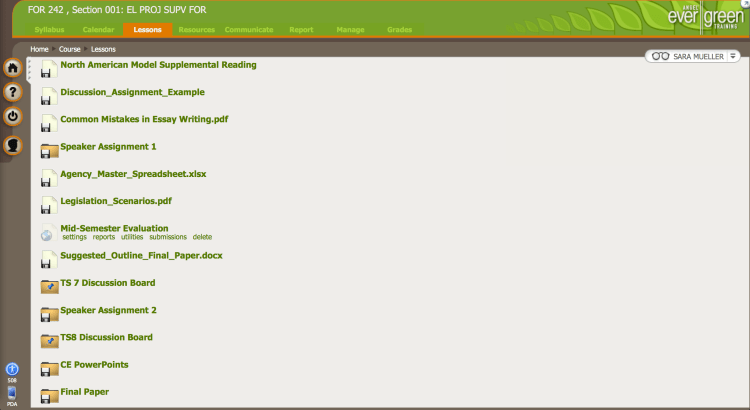
For those who are unfamiliar with the term, ANGEL is an online course management system. I have the ability to post lectures, readings, quizes, and dropboxes for all students to access. I may also use its gradebook feature to alert students of their grades. I have continued to use this platform with mixed results, but I look forward to using CANVAS in the future.
 Sara Mueller